
Dubai is a city where tradition and modern life come together, making it a popular place for couples who want to get married in Dubai. For expatriates and tourists, the legal process can seem confusing at first. In 2026, the UAE updated its family laws to make getting married in Dubai simpler and more welcoming for people of all nationalities and religions. Whether you want a civil marriage or a religious ceremony, this article explains the process in a clear and easy way.
The New Legal Landscape: Civil vs. Sharia
The first thing every foreigner must understand is that Dubai offers different legal frameworks based on your religion.
Civil Marriage (For Non-Muslims): Thanks to Decree-Law No. 41 of 2022, non-Muslim foreigners can now marry under a secular “Civil Marriage” law. This is a non-religious legal contract conducted at the Dubai Courts. It is very popular in 2026 because it is based on gender equality and does not require the bride’s father’s consent or a religious ceremony.
Sharia Marriage (For Muslims): If at least one partner is Muslim (typically the groom), the marriage must be conducted according to Sharia principles. This process is handled by the Sharia Courts or by a licensed marriage officer (Mazoon). It involves specific cultural requirements, such as the presence of the bride’s guardian and two male Muslim witnesses.
The Residency Rule: Dubai vs. Abu Dhabi
In 2026, an important rule remains in place for weddings within the Dubai Courts: At least one of the parties (the groom, the bride, or the bride’s legal guardian) must have a valid UAE residence visa.
If you are both tourists and do not have residency in Dubai, you have two options:
- Marry in Abu Dhabi: The Abu Dhabi Civil Family Court allows tourists to marry without a residence visa. It is a very efficient “express” service for international couples.
- Embassy Marriage: Some foreigners marry at their respective embassies or consulates in Dubai, though this depends entirely on your home country’s specific laws.
Must Pre-Marital Medical Screening
Health is a priority in the UAE. Before any marriage can be legally registered, the couple must undergo a Pre-marital Medical Certificate at a government-approved health facility (such as DHA primary healthcare centers).
The screening checks for:
- Infectious diseases (HIV, Hepatitis B, and Syphilis).
- Genetic blood disorders (Beta-thalassemia and Sickle Cell Anemia).
- Rubella immunity (for the bride).
The certificate is usually valid for three months. In 2026, you can book these tests online via the DHA app, and results are typically delivered digitally within 24 to 48 hours.
Document Checklist and Attestation
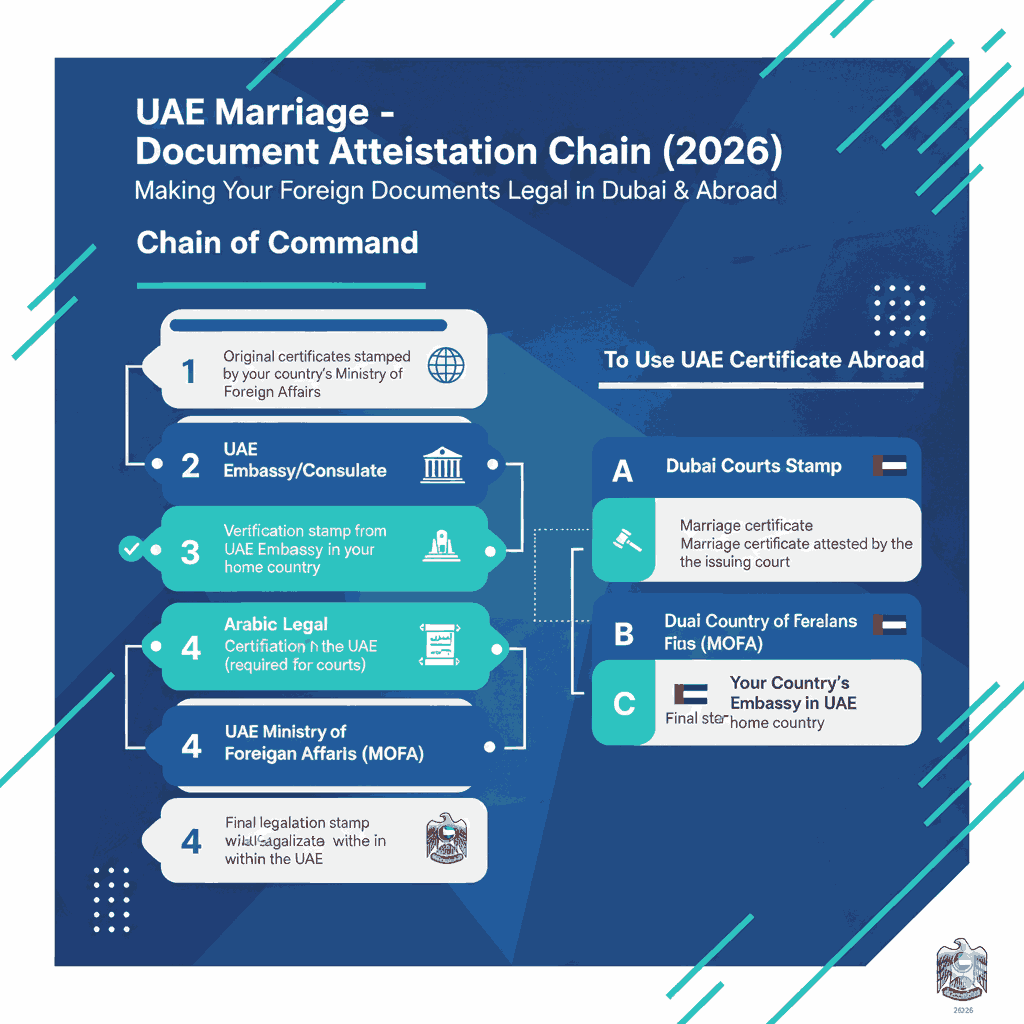
Paperwork is the most time-consuming part of the process. All foreign documents must be legally translated into Arabic and attested (legalized) through a specific chain:
- The Ministry of Foreign Affairs in your home country.
- The UAE Embassy in your home country.
- The Ministry of Foreign Affairs (MOFA) within the UAE.
The Essential Documents:
- Passports and Emirates IDs: Original and copies.
- Birth Certificates: For both parties.
- Proof of Marital Status: You must provide a “Single Status Certificate” or a “Certificate of No Impediment” from your embassy or home country.
- Divorce Certificate: If applicable, original attested copies must be provided to prove you are legally free to remarry.
The Process for Civil Marriage in Dubai (Non-Muslims)
The 2026 process for a civil wedding in Dubai is highly digital:
- Online Application: Submit your request through the Dubai Courts website or an Al Adheed center. You will need to upload your digital documents.
- Consent and Disclosure: Both parties sign a disclosure form confirming they are not currently married to anyone else and that they consent to the union.
- The Ceremony: Once approved, you are given an appointment. The ceremony is a brief legal proceeding where a judge validates the contract. You can have guests, but the process itself is focused on the legal signatures.
- Issuance: The digital marriage certificate is issued almost immediately, which is then stored in your UAE Pass account.
The Process for Sharia Marriage in Dubai (Muslims)
Islamic marriages follow a more traditional path:
- Mahr: The groom must provide a dowry (Mahr) to the bride. This is an essential part of the contract.
- The Wali: The bride’s father or a male guardian (Wali) must be present to give consent. If the father is deceased, the next closest male kin (brother or uncle) must attend.
- Witnesses: Two male Muslim witnesses with original identification must be present.
- Interfaith Rules: A Muslim man can marry a Christian or Jewish woman. However, a Muslim woman cannot marry a non-Muslim man unless he officially converts to Islam and provides the conversion certificate.
Costs and Timelines For Marriage in Dubai
Getting married in Dubai involves several layers of fees. In 2026, the estimated costs are:
- Medical Screening: AED 250 – AED 900 (depending on the center).
- Court Fees: Approximately AED 480 – AED 500 for standard civil marriage.
- Attestation Fees: AED 150 – AED 160 per document at MOFA UAE.
- Translation Fees: AED 150 – AED 300 per document.
Timeline: You should start the document attestation process at least 2 to 3 months before your wedding date. Once the documents are ready, the court appointment usually happens within 1 to 10 working days.
Making Your Marriage Legal Abroad
A marriage certificate issued in Dubai is a local legal document. To make it valid in your home country (for example, for taxes or a spouse visa), you must perform a “Reverse Attestation.”
- First, get the certificate stamped by the Dubai Courts.
- Second, get it attested by the UAE Ministry of Foreign Affairs (MOFA).
- Finally, take it to your country’s Embassy or Consulate in the UAE to be legalized for use in your home country.
Dubai offers a unique blend of modern legal efficiency and beautiful ceremony options. While the paperwork—especially the attestation and translation—requires strict attention to detail, the 2026 digital systems have made it much easier than in previous years. By choosing the correct path (Civil or Sharia) and ensuring your residency status is in order, you can successfully navigate the legalities and focus on your celebration.
FAQS regarding Getting Married in Dubai
1. Can two tourists get married in Dubai?
No. To marry specifically in the Dubai Courts, at least one partner (or the bride’s legal guardian) must have a valid UAE residence visa and an Emirates ID.
- Solution for Tourists: If both of you are on a visit visa, you should apply at the Abu Dhabi Civil Family Court. Abu Dhabi allows tourists to marry without residency, often through an “Express Service” that can be completed in 24 hours.
2. Is the pre-marital medical test mandatory for everyone?
It depends. * For Sharia Marriage: Yes, it is strictly mandatory for all couples.
- For Civil Marriage (Non-Muslims): While it was traditionally required for all, some recent 2026 updates for the Civil Marriage track have made it optional or simplified for certain nationalities. However, it is highly recommended to check your specific court appointment details, as most government-linked residency services will still ask for it.
3. Can a Muslim woman marry a non-Muslim man?
Under UAE Law, a Muslim woman cannot marry a non-Muslim man unless he officially converts to Islam. He must provide a legalized “Certificate of Conversion” before the marriage can be registered. Conversely, a Muslim man is permitted to marry a non-Muslim woman if she is Christian or Jewish (People of the Book).
4. Do we need to bring witnesses to the court?
- Sharia Marriage: Yes, you must bring two male Muslim witnesses with their original Emirates IDs or passports.
- Civil Marriage: You are generally required to have two witnesses (of any religion/gender over 21), but the modern Dubai Civil Court process is increasingly flexible. Always confirm this during your online application.
5. How much does the entire process cost?
While prices can change, here is a rough estimate for 2026:
- Medical Screening: AED 250 – AED 900.
- Court Fees: AED 480 – AED 500 (Standard).
- Attestation (MOFA): AED 150 per document.
- Translation: AED 150 – AED 300 per page.
- Total Estimate: Budget between AED 2,500 and AED 4,000 for all legalities.
6. Is a Dubai marriage certificate recognized in my home country?
Yes, but only after it is fully attested. A marriage certificate issued by Dubai Courts is only a local document. To use it for a spouse visa or legal matters in your home country, you must get it stamped by the UAE Ministry of Foreign Affairs (MOFA) and then by your country’s Embassy/Consulate in the UAE.
7. How long does the process take from start to finish?
If you have all your documents ready and attested from your home country, the local process (Medical + Court Appointment) can take 1 to 2 weeks. However, if you still need to get documents from abroad, you should plan for at least 2 to 3 months.
8. What is the minimum age for marriage?
- Civil Marriage: 21 years old.
- Sharia Marriage: 18 years old (though a judge’s special approval is needed if one party is significantly younger).